
Car Key Fob Not Working? 9 Fixes to Try Before You Call Anyone
Car Key Fob Not Working? 9 Fixes to Try Before You Call Anyone
Key fob stopped working? Start with the 60-second checks Waco drivers can do free.
Key Fob Troubleshooting Guide
You’re standing in a parking lot, pressing the unlock button, and your car is ignoring you completely. Maybe it’s the H-E-B lot on a 102° afternoon. Maybe it’s your own driveway at 6 a.m. Either way, a dead key fob has a special talent for picking the worst possible moment.
Here’s the good news: most key fob failures are not expensive. The three most common causes — a dying fob battery, a fob that lost sync after a battery change, and a weak car battery — cover the large majority of cases, and two of them you can check in under a minute for free.
Work through this guide in order. It starts with the fastest tests, moves to the fixes, and ends with the honest answer to the question everyone asks: what is this going to cost me if I can’t fix it myself?
Already locked out in Waco and need a reliable locksmith right now?
Mobile locksmith serving Waco and McLennan County
Start here: match your symptom
Different symptoms point to different problems. Find your row before you start taking anything apart.
| What your fob is doing | Most likely cause | Go to |
|---|---|---|
| Nothing at all — no lock, unlock, or trunk | Dead fob battery, or the car’s 12V battery is dead | Fix 1, then Fix 7 |
| Range keeps shrinking — you have to stand closer and closer | Fob battery dying slowly | Fix 1 |
| Worked this morning, dead after work, fine again by evening | Heat-soaked battery (very common in Texas) | The Texas heat section |
| Stopped working right after you changed the battery | Wrong cell, sticker left on, loose contacts, or lost sync | Fix 2 and Fix 3 |
| Unlocks fine, but the car won’t start — “Key Not Detected” | Car can’t sense the fob’s chip, or weak 12V battery | Fix 4 |
| Only one button stopped working | Worn-out button contacts inside the fob | Fix 8 |
| Both fobs died at the same time | Almost never the fobs — it’s the car | Fix 7 |
| Works everywhere except one parking lot | Radio interference at that spot | Fix 7 |
The 60-second test: if you have a spare fob, try it. Spare works, main fob doesn’t? The problem is inside your main fob. Both dead? Skip ahead to Fix 7 — your car is the problem, not the fobs.
FIX 1
Fix 1: Replace the fob battery — the right way
About two-thirds of the “dead fob” calls a locksmith gets would have been solved by a fresh battery. But there are four ways people get this wrong:
- Wrong battery. Your fob wants a specific coin cell — usually a CR2032 or CR2025, sometimes a CR1632. The number is printed on the old battery and inside the case. A thinner CR2025 will fit in a slot designed for a CR2032, and it will almost work, which is worse than not working at all.
- Stickers left on. Many new coin cells come with a peel-off sticker protecting the contacts. If you don’t remove it, the battery can’t make contact. People do this more often than you’d think.
- Wrong polarity. The positive side (marked +) must face the correct direction — check the diagram inside the case, not just how the old battery sat, because the old battery might have been wrong too.
- Cheap multipacks. A bargain 20-pack of batteries that’s been sitting in a warehouse for two years may arrive half-dead. Buy from a store with turnover, and check the date on the package.
Pop the case with a small flathead screwdriver or a coin in the seam — don’t use a knife, because you’ll chew up the plastic clips. Swap the battery, press the case back together until it clicks, and test every button.
FIX 2
Fix 2: Still dead with a new battery? Check these before assuming the worst
- Clean the contacts. Look at the metal battery contacts inside the case. If they’re green, dull, or bent, clean them gently with a pencil eraser or a cotton bud dipped in rubbing alcohol, and bend them back so they press firmly against the battery.
- Check the case. If the fob rattles or the case doesn’t click fully shut, the battery may not be making steady contact. A cracked case from years of drops can flex just enough to break the connection.
- Test the LED. Most fobs have a tiny light that blinks when you press a button. No blink with a new battery means the fob’s circuit board is likely the problem — move to Fix 8. Blinks but the car ignores it? That’s a sync problem — Fix 3.
- Try the spare. If your spare fob works fine, you’ve confirmed the car is OK and the problem is isolated to this one fob.
FIX 3
Fix 3: The fob lost sync after a battery change? Resync it
Sometimes a battery swap resets the fob’s rolling security code and the car stops recognizing it. Many cars let you resync the fob yourself:
- Door method: sit in the driver’s seat, close all doors, and cycle the locks with the power lock button — lock, unlock, lock — then press any button on the fob twice.
- Ignition method: put the key in the ignition (or press the start button with the fob), turn to the “on” position without starting the engine, press any fob button, then turn off. Repeat two or three times.
The exact sequence varies by make and model — your owner’s manual has it under “keyless entry” or “remote programming.” If neither method works after a few tries, the fob may need professional reprogramming rather than a simple resync.
FIX 4
Fix 4: “Key Not Detected”? Here’s how to start your car anyway
This is the message that causes the most panic: the doors unlocked fine, you pressed the start button, and the dashboard says “Key Not Detected” or “No Key Found.” Nine times out of ten, the fob battery is too weak to broadcast, but the fob’s passive chip still works — and the car has a backup way to read it.
The workaround is built into almost every push-button-start car: hold the fob directly against the start button and press the button with the fob itself. The car can read the chip at point-blank range even when the fob battery is nearly dead. If that works, drive straight to buy a battery — and know that this trick will keep working until you replace it.
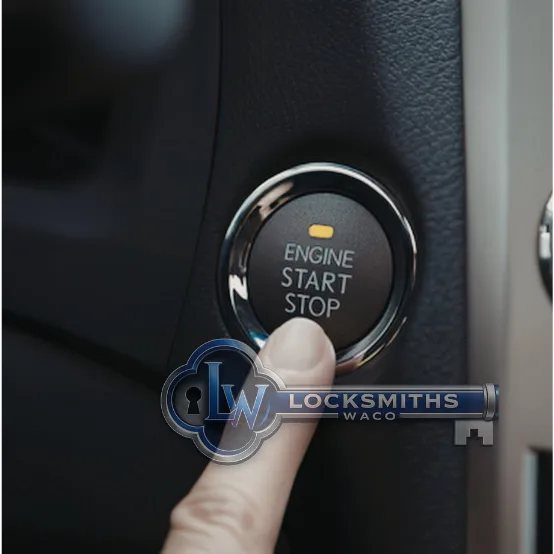
Some brands use a backup slot instead of the button trick. Common ones:
| Brand | Backup spot for a dead fob |
|---|---|
| Chevrolet / GMC | Center console cupholder area or the slot inside the console |
| Ford / Lincoln | Backup slot in the center console or under the cupholder mat |
| Toyota / Lexus | Hold the fob against the start button |
| Honda / Acura | Hold the fob against the start button |
| Nissan / Infiniti | Slot in the center console or glove box area |
| Jeep / Dodge / Ram | Center console bin — press the fob against the start button if there’s no slot |
If the button trick doesn’t work and the dashboard lights look dim or flicker, the car’s 12V battery is the real problem — jump to Fix 7.
TEXAS HEAT
The Texas heat section: why Waco fobs die young
Here is the thing no national guide will tell you, because most of them are written where summers are mild: heat is a key fob killer, and Texas has it in bulk.
A car parked in the Waco sun on a 100° day can see cabin temperatures climb past 130–140°. Coin-cell batteries hate that. Heat speeds up the chemical breakdown inside the cell, so a battery that might last three or four years in a mild climate can be done in well under two here — and a fob that lives on the dashboard, in the glovebox, or in a console cup holder is baking at the maximum temperature every single day.
Heat produces a signature failure pattern that local drivers describe again and again:
- The fob works fine in the morning.
- After the car sits in a hot parking lot all day, the range shrinks or the fob quits entirely.
- By evening, once everything cools down, it mysteriously works again.
If that sounds familiar, your fob isn’t haunted — it’s a marginal battery being exposed by heat. Heat usually doesn’t kill a healthy battery outright; it pushes a weak one over the edge, which is exactly why the failure comes and goes with the temperature. Replace the cell (Fix 1) before you replace the fob.
Heat’s second victim matters even more: your car’s 12V battery. Texas heat is harder on car batteries than northern winters, and batteries here commonly give up in two to three years instead of the four to five you might expect up north. A weak 12V battery is one of the top hidden causes of “Key Not Detected” messages and fobs that seem to die for no reason — the fob gets blamed for the car battery’s failure.
And one habit to break tonight: if your fob lives on a hook right inside the door — within range of the car in the driveway or garage — many proximity fobs keep quietly communicating with the car, and that constant chatter drains the fob battery in weeks instead of years. Move the keys to a spot well away from the car and see if your “mystery drain” disappears.
FIX 5
Fix 5: Locked out right now? Use the hidden key
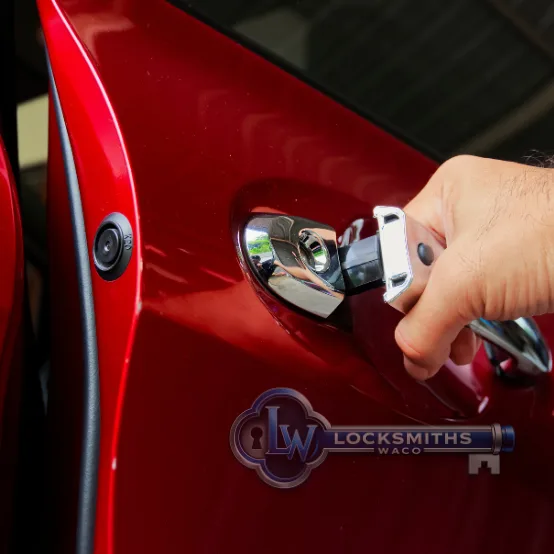
If the fob is completely dead and you’re locked out, you probably have a key in your hand already and don’t know it. Nearly every fob has a hidden mechanical key inside: look for a small release button or latch on the back, and the metal key slides or flips out.
No visible keyhole on the door? It’s hidden too. On most cars there’s a small cover on the driver’s door handle with a slot underneath it. Slide a small screwdriver (not the key — you’ll scratch paint and the cover’s plastic clips snap easily) into the slot, lever gently, and the cover pops off to reveal the lock cylinder.
Two things to expect:
- The alarm will probably go off when you open the door with the metal key. Don’t panic — it stops once you start the car, or by cycling the key in the ignition on cars that still have one.
- Once you’re in, use the fob-to-button method from Fix 4 to start the car, then go buy a battery.
If your fob genuinely has no physical key at all (a few newer models), or the door was replaced after an accident and the lock cylinder was never moved over — yes, that happens — that’s when it’s time to call for an entry. In Waco, that’s a mobile automotive locksmith job: automotive locksmith in Waco.
FIX 6
Fix 6: Water damage — act fast, skip the rice myths
Dropped your fob in the lake at Cameron Park or ran it through the wash? Speed matters more than technique:
- Pop the fob open and remove the battery immediately — powered electronics corrode far faster than unpowered ones.
- Shake out the water, dry everything with a soft cloth, and clean any white or green corrosion off the contacts with a cotton swab and a little isopropyl alcohol.
- Leave the fob open in front of a fan for 24–48 hours before putting a fresh battery in (never reuse the dunked one).
If it still doesn’t work after a proper dry-out, the board is likely damaged — that becomes a replacement conversation (see costs below).
FIX 7
Fix 7: When the fob isn’t the problem at all
Sometimes the fob is innocent. Three car-side causes fool everyone:
- Both fobs failed together. Two fobs almost never die on the same day. If both quit, check the car’s 12V battery first — especially if it’s two or three summers old (see the heat section). Dim dash lights, slow cranking, or clicking when you try to start confirm it.
- A blown fuse. The keyless-entry system has its own fuse. Find it in your manual’s fuse chart and test it — pull it and check continuity or use a test light. Fuses that “look fine” fail this test regularly.
- One parking lot. If your fob fails at one specific place — the same store, the same office lot — but works everywhere else, that’s radio interference, not a dying fob. Powerful LED signs, transmitters, and some security systems can drown out a fob’s signal. Park a few rows away and test again before spending a dollar. Real cases have been traced to a single electronic billboard.
There’s also a folk fix worth addressing honestly: holding the fob to your chin to extend its range. It can genuinely add a few feet of range (your head acts as a crude antenna), which makes it a fine trick for finding your car — but it fixes nothing, and if you need it every day, your battery is telling you something.
FIX 8
Fix 8: Only one button stopped working
Lock works but unlock doesn’t? Trunk button dead but panic fine? That pattern points inside the fob: the rubber button’s conductive pad or the contact beneath it is worn or dirty. Open the fob, clean the contacts and the underside of the rubber pad with a cotton swab, and reassemble. If a pad is visibly worn smooth, replacement fob shells (which reuse your circuit board) cost far less than a whole new fob. If the board itself is damaged, an RF signal test at a locksmith can confirm in seconds whether the fob is transmitting at all — ask for that test before buying a replacement.
A Texas truck note: F-150s, Silverados, and Ram 1500s are the most common vehicles in McLennan County, and their fobs live hard lives — dust, drops, and 140° cabs. If you bought a used truck that came with only one fob, treat getting a spare as this month’s job, not someday’s. A spare made while you still have a working fob is dramatically cheaper than an all-keys-lost replacement (see below).
COSTS
What it costs if you can’t fix it yourself
Honest ranges, based on what drivers actually report paying:
| The fix | DIY | Mobile locksmith | Dealership |
|---|---|---|---|
| Fob battery | $3–$5 | — | Often $10–$25 with labor |
| Fob programming (you supply the fob) | Sometimes free (manual procedure) | ~$50–$150 | ~$150–$400 |
| New fob + programming | — | ~$200–$600 for smart fobs | ~$400–$900+ for smart fobs |
The other cost is time. A dealership route often means towing the car in and waiting days for an ordered fob. A mobile locksmith comes to the car, and most fob jobs are finished in the same visit. Whichever route you choose, have your photo ID and registration or title ready — any legitimate locksmith or dealer will ask for proof the vehicle is yours before making or programming a key. More local numbers are in our Waco locksmith cost guide.
When it’s time to call a locksmith
Do the free checks first — genuinely, most fob problems die at Fix 1. Call a professional when:
- A fresh, correct battery (sticker off, contacts clean) changes nothing
- The dash says “Key Not Detected” and the fob-to-button trick fails
- Both fobs are dead and the car battery tests fine
- You have only one fob left and it just stopped working — or it’s lost entirely
- You’re locked out and your fob has no hidden key
When you call, say the year, make, and model, describe the symptom from the table at the top, and mention what you’ve already tried. That two-minute description can be the difference between a battery errand and the right technician with the right fob on the truck. If your fob is beyond repair, our car key replacement service in Waco covers cutting and programming for most makes — and for anything after hours, the emergency locksmith page is the fastest route. Or just call (254) 489-5888.
Need a trusted local locksmith in Waco, TX? Call us directly — no call centers, no dispatch fees, upfront pricing every time.
Serving Waco · Hewitt · Woodway · Robinson · Bellmead · McLennan County
Prevention: the 5-minute habits that stop the next failure
- Get a spare fob while the first one still works. It is always the cheapest time.
- Change fob batteries on a schedule — every two years in Texas, yearly if the fob lives in the car.
- Keep a spare coin cell in your wallet or purse — not in the glovebox, where it bakes.
- Store the fob away from the car at home so it isn’t draining itself talking to the car all night.
- Never ignore the dash’s “key battery low” warning. It’s giving you a head start most people waste.
Frequently asked questions
Why did my key fob suddenly stop working?
Most sudden failures are the fob’s coin battery finally crossing the line from weak to dead — often pushed over by a hot day. If a new, correct battery doesn’t revive it, the next suspects are lost sync (Fix 3) and the car’s 12V battery (Fix 7).
Why is my key fob not working after I replaced the battery?
The big four: the wrong cell (CR2025 in a CR2032 fob), the protective sticker left on the new battery, loose or dirty contacts, or a case that didn’t click fully shut. After those, a resync (Fix 3) handles most of the rest.
How do I start my car if the key is not detected?
Hold the fob against the start button and press the button with the fob — the car can read the chip at point-blank range even with a nearly dead fob battery. Some brands use a backup slot in the console instead (Fix 4). If that fails and the dash looks dim, your 12V battery is the likely culprit.
Why does my fob battery keep dying in days or weeks?
Usually the fob is stored within range of the car and never stops communicating with it — a hook by the door with the car in the driveway is the classic setup. Move the fob farther away. A fob that still drains in days has an internal fault and needs testing or replacement.
Both of my fobs stopped working at the same time. What’s wrong?
Almost certainly the car, not the fobs: check the 12V battery first, then the keyless-entry fuse. Two fobs dying on the same day by coincidence is rare enough to rule out until the car checks clean.
Will the alarm go off if I open the door with the hidden key?
Usually, yes — the car treats a manual unlock as suspicious until it sees the key start it. It stops once the engine starts (or the key cycles in the ignition). It’s noisy and embarrassing, but harmless.
Can Texas heat really kill a key fob battery?
It kills them early, yes. Cabin temperatures past 130° accelerate the chemical breakdown inside coin cells, so Texas fob batteries live shorter lives than the same batteries up north — and the tell-tale sign is a fob that fails on hot afternoons and recovers by morning.
My fob is blinking red after a battery change. What does that mean?
On most fobs, a blinking red LED just confirms a button press is being transmitted — it’s the fob talking, not an error.
Need a trusted local locksmith in Waco, TX? Call us directly — no call centers, no dispatch fees, upfront pricing every time.
Serving Waco · Hewitt · Woodway · Robinson · Bellmead · McLennan County
🔑
Locksmiths Waco — Mobile Locksmith Service
Serving Waco and McLennan County. Residential, automotive, and commercial locksmith services with upfront pricing and no call centers. Mobile: locksmithwacotx.com